GoHighLevel
 Slack
Speed to lead is the time between a lead reaching out and your first real reply. I'm Eric Forte, a GoHighLevel and n8n AI automation engineer, and when I set this up for a business, I watch two clocks. One is how fast your team finds out a lead came in. The other is how fast the lead hears back.
Automation owns the first clock. Your team owns most of the second. On a build for a pest control company, the first clock measured a median of 13 seconds over three weeks of real leads. Below are the studies behind the numbers and the GoHighLevel setup I use.
Key Takeaways
- Speed to lead runs on two clocks: how fast the team knows about a lead, and how fast the lead hears back.
- The 5-minute rule comes from a 2007 study of six companies' call data: the odds of reaching a lead were about 100 times higher at 5 minutes than at 30.
- In a 2026 study of 31 home-service brands (3,211 evaluations), 72% got no follow-up at all within 24 hours.
- An instant text buys time. Your team still has to reply, and a fast alert is how they find out.
- On a lead alerts build for a pest control company, the median time from a new lead to its Slack alert was 13 seconds.
What is speed to lead?
Speed to lead measures how long a new lead waits for a real reply after they fill out a form, call or send a message. In sales it's often called lead response time. A real reply means a person or a useful message that moves the conversation forward. An auto-receipt that says "we got your message" doesn't count.
Speed to lead is two clocks. The first is the alert clock: how long until someone on your team knows the lead exists. The second is the reply clock: how long until the lead hears back. A slow alert clock means a fast team still replies late. A fast alert with nobody free to answer still needs an instant text to hold the lead until someone is.
Speed to lead statistics: what the studies found
Most speed to lead pages repeat the same few numbers without saying where they came from. Here's what each study measured, who it looked at, and when.
Speed to lead studies compared
Lead Response Management study (MIT and InsideSales)
- Who and when
- Three years of call data from six companies using InsideSales software, 2007
- What it measured
- Odds of reaching and qualifying a lead by when the first call was made
- Finding
- About 100 times more likely to reach the lead and 21 times more likely to qualify it at 5 minutes than at 30
Harvard Business Review
- Who and when
- Online lead response across companies, 2011
- What it measured
- How fast companies responded to web leads
- Finding
- Most companies were not responding nearly fast enough
Pied Piper PSI
- Who and when
- 3,211 evaluations of 31 national home-service brands, late 2025 to early 2026
- What it measured
- Follow-up within 24 hours after a call, chat or web form
- Finding
- No follow-up at all 72% of the time
Clay
- Who and when
- 6,346 B2B companies across industries, 2026
- What it measured
- Replies to demo and contact forms
- Finding
- About two-thirds never replied
ServiceTitan
- Who and when
- 1,018 roofing companies, late 2025
- What it measured
- Self-reported reply time
- Finding
- 67% said they reply to leads within four hours
| Study | Who and when | What it measured | Finding |
|---|---|---|---|
| Lead Response Management study (MIT and InsideSales) | Three years of call data from six companies using InsideSales software, 2007 | Odds of reaching and qualifying a lead by when the first call was made | About 100 times more likely to reach the lead and 21 times more likely to qualify it at 5 minutes than at 30 |
| Harvard Business Review | Online lead response across companies, 2011 | How fast companies responded to web leads | Most companies were not responding nearly fast enough |
| Pied Piper PSI | 3,211 evaluations of 31 national home-service brands, late 2025 to early 2026 | Follow-up within 24 hours after a call, chat or web form | No follow-up at all 72% of the time |
| Clay | 6,346 B2B companies across industries, 2026 | Replies to demo and contact forms | About two-thirds never replied |
| ServiceTitan | 1,018 roofing companies, late 2025 | Self-reported reply time | 67% said they reply to leads within four hours |
The 2007 study shows how fast the odds of reaching a lead drop. The 2026 home-service and B2B numbers show that plenty of leads still never hear back at all, so for a lot of businesses the first win is replying every time, and replying fast comes next.
What is a good speed to lead?
A good speed to lead is a first reply within 5 minutes during work hours, and an instant first text at any hour. The 5-minute number comes from the 2007 study, which compared calls at 5 minutes with calls at 30. It came from six companies' data in one vendor's software, analyzed with an MIT researcher and not peer-reviewed, so it's a strong signal rather than a law. It also doesn't say anything about the first minute.
Customers expect fast replies too. In Jobber's 2026 survey of 1,050 home-service business owners, owners said over 70% of their customers expect a same-day response, and more than half expect one within the hour. Calls have their own gap: Invoca's 2026 home-services benchmarks found that 52% of calls were answered by a person.
So if your team can call within 5 minutes, great. If they can't always, start with replying to every lead the same day, then shrink it.
Does an automated reply count?
An automated text counts when it starts a real conversation. A text that names your business, says who will follow up, and asks one easy question (like the address or the best time to call) gives the lead a reason to answer. A bare "thanks, we got your message" doesn't.
Even a good automated text only buys time. Someone still has to pick the conversation up, and they can't until they know it's there.
How I automate speed to lead in GoHighLevel
This is the setup I use when a business runs its leads through GoHighLevel. It's built for the first clock, so the team knows about a lead within seconds.
- I send every lead source into one GoHighLevel sub-account. Forms, ads, calls and lead apps all land in the same place, so nothing sits in a separate inbox.
- Each source gets a workflow that tags the lead and sends an instant first text, so the lead hears from you right away.
- I alert the right person where they already work. GoHighLevel's own Slack action can't add buttons and, in a private channel, posts as the person who connected Slack, so I send the lead through Zapier or n8n and post the alert from a bot, with a button that opens the lead.
- I turn on missed-call text-back, so a missed call starts a text conversation instead of a dead end.
- I measure the alert time: when the lead was created in GoHighLevel, and when the alert arrived.
I built the alert part of this for a pest control company. Before, leads came in through several tools, and the team could take days, sometimes up to a week, to notice one. Now every lead source lands in one GoHighLevel sub-account and sends a Slack alert. Over three weeks of real leads, the median time from a new lead to its alert was 13 seconds, and 9 in 10 alerts arrived in under 30 seconds (the lead alerts case study). That's the alert clock. The reply clock depends on the team, and this build doesn't measure it.
The same idea shows up in other builds: a Facebook lead pipeline that gets ad leads into GoHighLevel, a Typeform lead catch-up, and a voice IVR that qualifies callers. More on this in lead follow-up automation.
How to measure your lead response time
You need two times for each lead: when it came in, and when it got its first real reply. In GoHighLevel, the contact's created date gives you the first, and the conversation history shows the second.
- I'd pull a few weeks of leads, so one slow day doesn't skew it.
- I'd use the median, not the average. One lead that waited two days can make the average look worse than most leads felt.
- I'd check after-hours leads on their own. A team that replies in 5 minutes at 2 pm and 14 hours at 9 pm has two different problems.
- I'd measure the alert clock and the reply clock separately, so you know which one to fix.
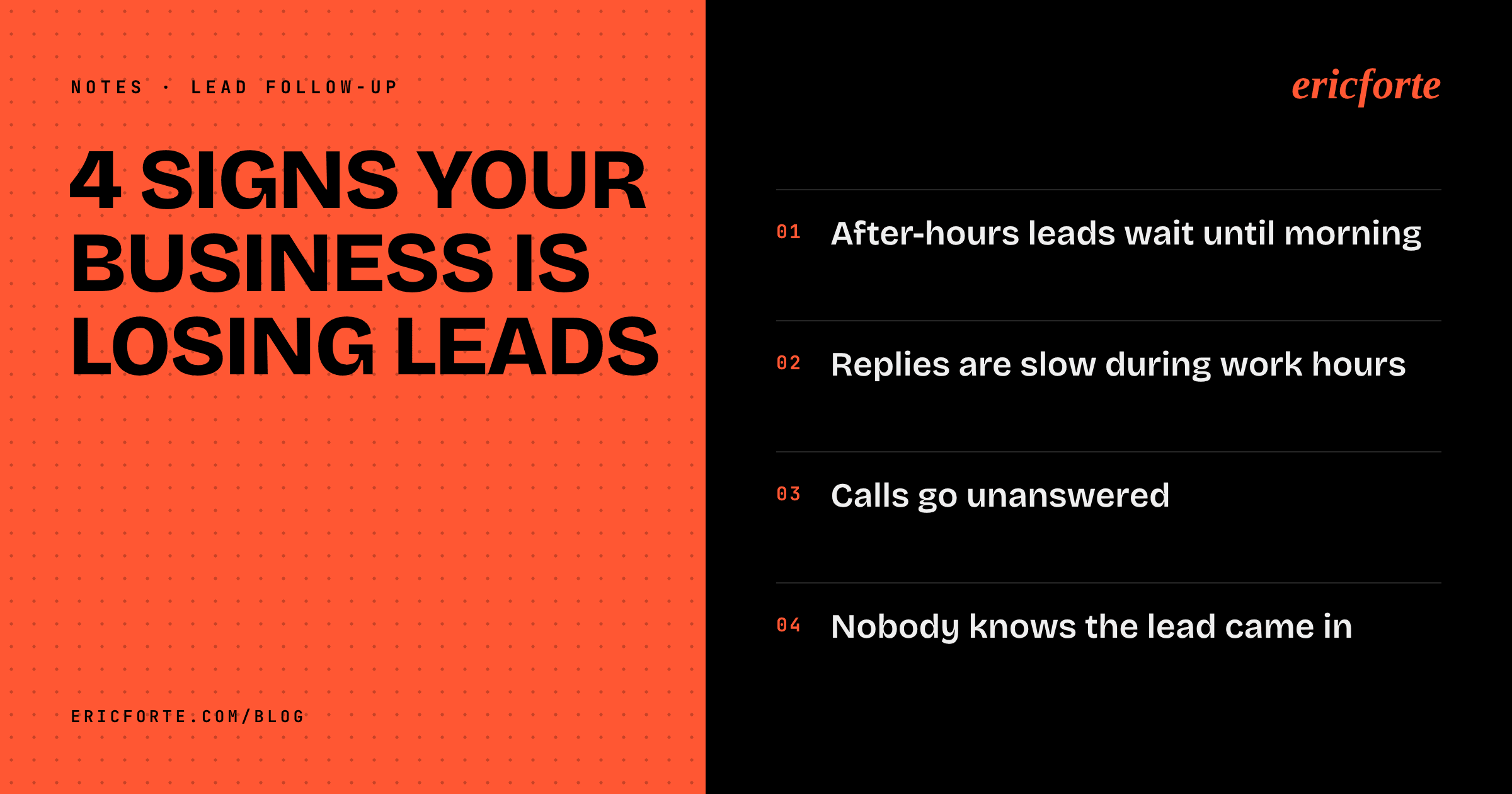
If the numbers point to leads slipping through in other places too, 4 Signs Your Business Is Losing Leads covers the other common gaps.
Frequently asked questions
What does speed to lead mean?
Speed to lead is how long a new lead waits for your first real reply after they reach out by form, call or message. It's also called lead response time. Faster replies reach more leads while they're still interested.
What is a good speed to lead?
Aim for a first reply within 5 minutes during work hours and an instant automated text at any hour. If you're far from that, replying to every lead the same day is the first step.
Where does the 5-minute rule come from?
It comes from the 2007 Lead Response Management study by MIT and InsideSales. It found the odds of reaching a lead were about 100 times higher, and of qualifying it about 21 times higher, when the first call came at 5 minutes instead of 30. The data came from over 15,000 leads at six companies using InsideSales software.
What did the Harvard speed to lead study find?
The Harvard Business Review article "The Short Life of Online Sales Leads" (2011) found that most companies were not responding to web leads nearly fast enough. Its authors include two of the people behind the 2007 Lead Response Management study.
Does an automated text count as a reply?
Yes, if it gives the lead something to answer, like a quick question about the job. A plain receipt doesn't. Your team takes it from there.
What about leads that come in after hours?
I'd send an instant text at any hour, so the lead knows they reached you and when to expect a call. Then those leads go first the next morning, and their response time gets tracked on its own.
Can GoHighLevel automate speed to lead?
Yes. GoHighLevel workflows can send an instant first text to every new lead, alert your team, and text back missed calls. For alerts with buttons that open the lead, I post them to Slack from a bot through Zapier or n8n.
Want a hand with yours?
If you want, I can look at where your leads wait between coming in and getting a reply. It's 30 minutes, and you keep the plan either way. Book a call.
Sources
- MIT / InsideSales, Lead Response Management Study (2007): Lead Response Management Study (PDF)
- Harvard Business Review, The Short Life of Online Sales Leads (2011): hbr.org
- Pied Piper PSI, Home Services Lead Handling Effectiveness study (2026): piedpiperpsi.com
- Clay, speed to lead experiment (2026): clay.com
- ServiceTitan, Roofing and Exteriors Market Report (2026): servicetitan.com
- Jobber, Home Service Trends Report (2026): getjobber.com/home-service-trends
- Invoca, Home Services Lead Conversion Benchmarks Report (2026): invoca.com

 n8n